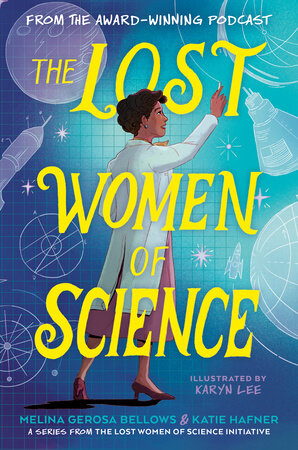
The Lost Women of Science 2
10 Women Who Changed the Formula and Rewrote History
Hardcover
Published on Apr 6, 2027 | 224 Pages
AmazonBarnes & NobleBooks A MillionBookshop.orgTargetWalmart
Ebook
Published on Apr 6, 2027 | 224 Pages
AmazonApple BooksBarnes & NobleBooks A MillionGoogle PlayKobo
Audiobook Download
Published on Apr 6, 2027 | 4 Hours 0 Minutes
Grades 3–7
Ages 8–12
The award-winning team behind The Lost Women of Science returns with ten more remarkable stories of female physicists, archaeologists, astronomers, doctors, and more whose contributions broke barriers and rewrote history.
Long before the history books took notice, women were already busy changing the world of science. Meet the physicist who worked alongside J. Robert Oppenheimer, the “Father of the Atomic Bomb”; the daredevil who designed, built, and flew her own airplane; the chemist who helped create a lifesaving cancer-fighting drug—and seven more incredible trailblazers who defied expectations and followed their curiosity to groundbreaking discoveries.
From the creators of the award-nominated Lost Women of Science podcast comes an illuminating and inspiring portrait of ten revolutionary women in STEM. With riveting sketches, rarely seen photos, and insightful stories, this book invites readers to uncover the remarkable lives and lasting triumphs of science pioneers whose impact will never be forgotten.
ISBN 9780593896754 (Hardcover)
Published on Apr 6, 2027
Published by Bright Matter Books
Pages 224
Dimensions 5-1/2 x 8-1/4
Age Range 8-12 years
Grade Grades 3-7
ISBN 9780593896761 (Hardcover Library Binding)
Published on Apr 6, 2027
Published by Bright Matter Books
Pages 224
Dimensions 5-1/2 x 8-1/4
Age Range 8-12 years
Grade Grades 3-7
ISBN 9780593896778 (Ebook)
Published on Apr 6, 2027
Published by Bright Matter Books
Pages 224
Age Range 8-12 years
Grade Grades 3-7
ISBN 9798217415793 (Audiobook Download)
Published on Apr 6, 2027
Published by Listening Library
Age Range 8-12 years
Grade Grades 3-7

The Lost Women of Science 2
February 8, 1831-March 9, 1895
I early conceived a liking for, and sought every opportunity to relieve the sufferings of others.
-Dr. Rebecca Lee Crumpler
Claim to Fame
America’s First Black Female Public Health Pioneer
Why
For her trailblazing work in disease prevention and public health advocacy
Firsts
First Black female physician in the US
First Black person to publish a medical book
An early advocate for disease prevention and a pioneer in public health
In 1865, the American Civil War had ended, and Rebecca Lee Crumpler was one year post-graduation from medical school in Boston. She had just married her second husband after losing her first. And she had newly become the first Black female to earn a medical degree in the United States.
But instead of staying in Boston with her new husband, Rebecca made a choice that would change countless lives. She traveled south to Virginia—into the heart of what had been Confederate territory—to care for war survivors and newly freed slaves. The work was dangerous. The conditions were terrible. But taking care of people was all she had ever wanted to do.
Dr. Rebecca Crumpler was more than America’s first Black female doctor. She was a fearless champion for people who had been left behind—especially those in poor Black communities. But the early life of this remarkable woman remains mostly a mystery.
Here’s what historians do know: Rebecca was born in 1831 in Christiana, Delaware, as Rebecca Davis. As a child, she went to live with her aunt in Pennsylvania. This aunt cared for sick neighbors and helped deliver babies, using home remedies and common sense.
In those days, most babies were born at home. Rebecca’s aunt was known for her skill, and young Rebecca often tagged along on visits to expectant mothers and sick patients. Watching her aunt help others made a powerful impression on Rebecca.
A New Life in Boston
In 1852, when Rebecca was twenty-one, she moved to Boston. Historians aren’t sure exactly why. She may have been looking for work as a nurse, even though she had no formal training. (Nursing schools like the ones we know today wouldn’t exist for another twenty years.)
Rebecca found a job in nearby Charlestown, caring for patients using the knowledge she’d gained while making rounds with her aunt. She also found love in Boston. In April of that year, she married Wyatt Lee, a man who had once been enslaved.
For about eight years, Rebecca worked as a nurse in and around Boston. She was so skilled that the doctors she worked with did something unusual: They recommended that she apply to medical school.
After thinking it over, Rebecca decided to go for it. She applied to the New England Female Medical College and got in. Abolitionists—people fighting to end slavery—both Black and white helped pay for her education.
When Rebecca started classes in 1860, there were about 55,000 formally trained doctors in the United States. Only 300 were women. And every single one of those women was white.
That didn’t stop Rebecca Lee. She threw herself into her studies, specializing in family medicine. “The focus of the New England Female Medical school was women and children, because at the time, men didn’t feel comfortable with maternity and childcare,” says Victoria Gall, a local historian and former president of the Friends of the Hyde Park Library. “They thought it was a woman’s job.”
Tragedy Strikes
Rebecca was more than halfway through medical school when disaster hit. Tuberculosis swept through Boston. People called it consumption in the mid-1800s, and no one knew what caused it. But everyone knew that getting sick with tuberculosis often meant death.
In the nineteenth century in Boston, tuberculosis killed more people than any other disease. The infection spread easily through the air, and crowded living conditions—as in the neighborhood where Rebecca and Wyatt lived—made it worse.
Tuberculosis
Tuberculosis, or TB for short, is an infectious disease that mainly affects the lungs but can also target other parts of the body. TB is caused by a bacterium called Mycobacterium tuberculosis. It is most commonly spread through the air when an infected person coughs, sneezes, or spits. The bacteria are released into the air, and if another person inhales just a few of these germs, they can enter the lungs and start infecting the body.
A microscopic image of Mycobacterium tuberculosis, the bacterium that causes TB.
When someone inhales the TB bacteria, they can develop one of two conditions related to TB. The first is latent TB. People with latent TB don’t show symptoms and cannot spread the disease to others. Some people never even realize they are infected. A skin test or a blood test can help diagnose a patient with latent TB and allow them to receive treatment to prevent the disease from becoming active and potentially life-threatening.
However, some cases of latent TB develop into active TB. Active TB occurs when the bacteria begin to grow inside the body. Although active TB usually affects the lungs, it can spread to the spine, kidneys, skin, and brain. Symptoms of active TB disease include a persistent cough, weakness, chest pain, high fever, fatigue, weight loss, and night sweats. Sounds pretty nasty, and it is.
People with active TB can easily infect others if they’re not careful. The challenge is that the symptoms of TB often don’t appear until a few months after infection. This means a person can spread TB without even knowing they have it. As of 2024, it’s estimated that about a quarter of the world’s population is infected with some form of TB. That’s pretty scary, but here’s the good news: TB is both preventable and treatable if caught early.
Doctors like Rebecca Crumpler figured out that reducing overcrowding in living situations, ensuring adequate access to food, and taking precautions with patients who were immunocompromised (meaning patients who might have a tough time fighting off disease) were some ways to help prevent the disease from spreading.
Later, medical professionals developed TB screening tools and medicines that can detect and cure TB, especially in countries like the United States. The trouble is that access to care is not equal across the globe, and the disease persists in countries with less access to tools for prevention and treatment. Health activists and health experts are vital in helping connect the cure with the communities who need it.
More in the The Lost Women of Science Series